The History and Distinctive Features of the Armenian Carpet
Discover the history and unique features of the Armenian carpet, a millennia-old weaving tradition passed down through generations of craftspeople.
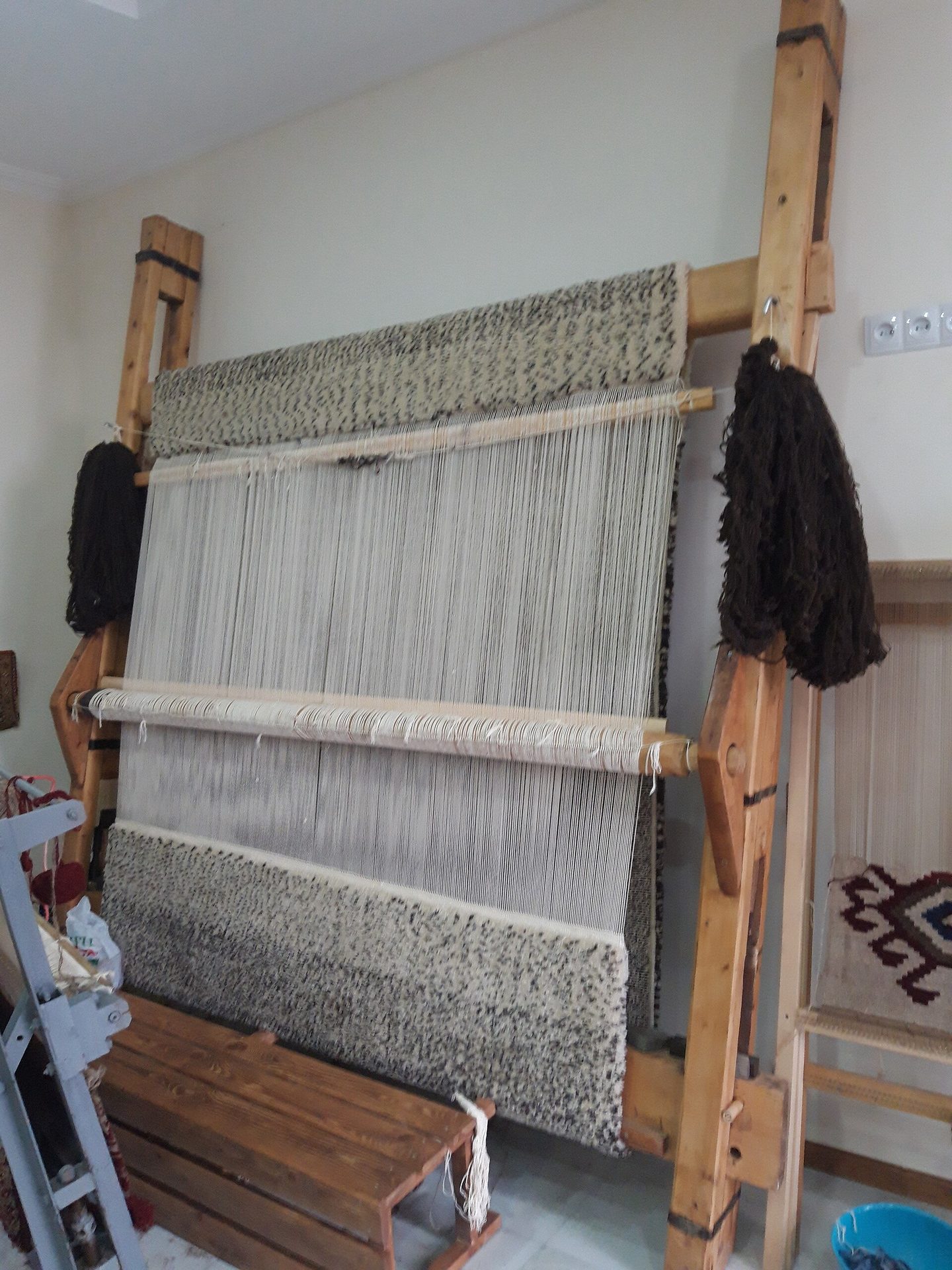
Photo: Ararat Trvants · CC BY-SA 4.0 · via Wikimedia Commons
When we speak of Armenia, the Armenian carpet is one of the main decorative arts that comes to mind, alongside the country’s wider heritage of art, music and literature. In Armenia, the art of weaving has been passed down from generation to generation, bearing witness to the country’s tradition and culture. Let us discover together the history and the distinctive features of the Armenian carpet.
The history of the Armenian carpet
The history of the Armenian carpet dates back to the 5th century BC. Indeed, the oldest carpet made by Armenians is found in the Hermitage Museum in Russia, nicknamed the “Pazyryk”. International experts have carried out extensive research to prove that the carpet was dyed with the pigment “vordan karmir” and features ornamentation typical of the Urartian style.
For centuries, the country’s traditional carpets have been made by hand by craftspeople from high-quality wool and dyed with natural colours. Each region has its own carpet design, with its own ornamentation and construction, so no two hand-made carpets are ever exactly the same. They may resemble one another at first glance, but look closer and every carpet tells you where it was born.
At the beginning of the 19th century, the development of infrastructure with the ports of the European states opened the international market to Armenian carpets, whose production experienced a sharp boom. According to the specialists, the 19th century was “the golden age of Armenian carpets”. It should be noted that the carpets are classified according to their main region of production and bear the name of the villages or towns where they were made.
The distinctive features of Armenian carpets
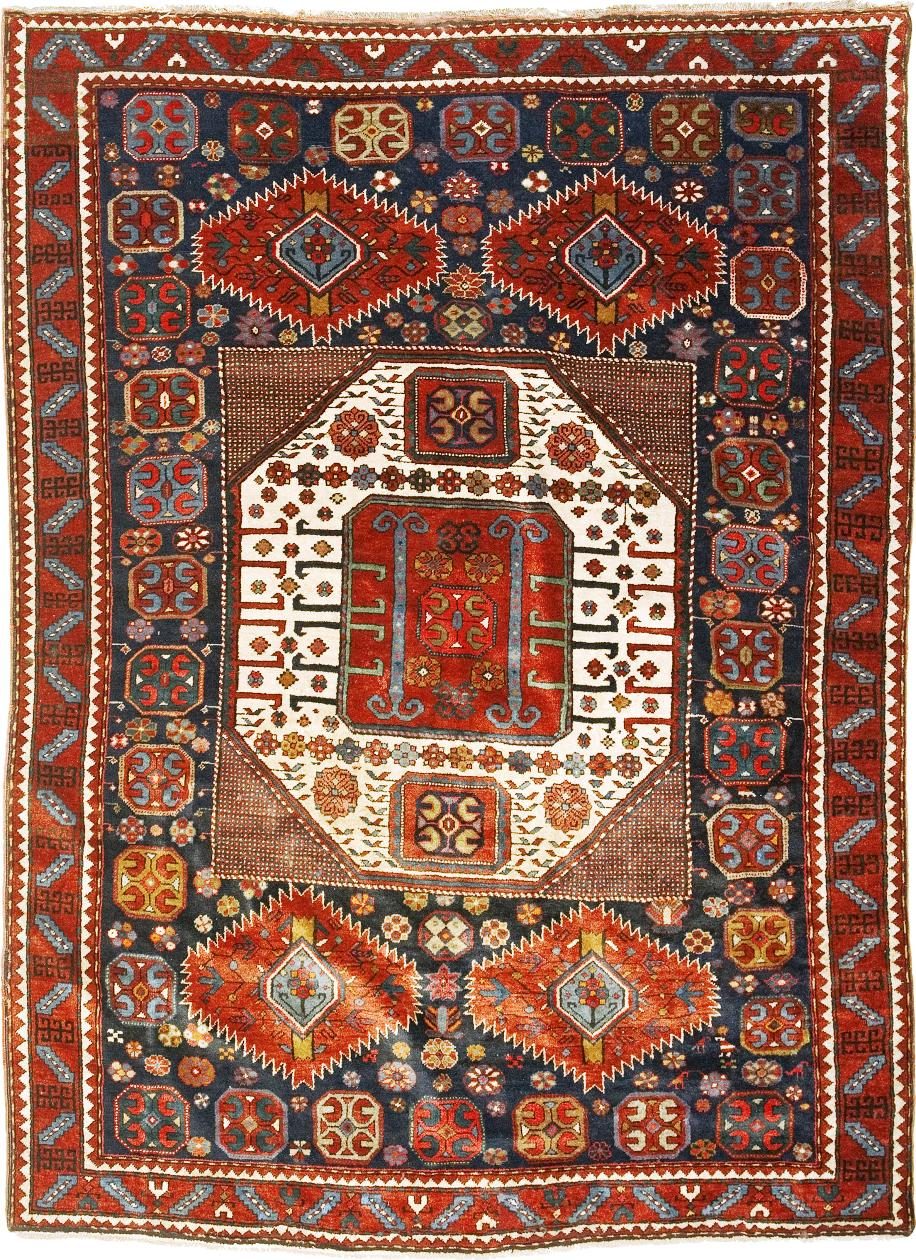
In general, the Armenian carpet is considered a state-and-territory element, like oriental carpets. However, the carpet made in Armenia has its own characteristics. According to the Swedish scholar F. R. Martin, the country is home to “dragon” carpets. In his book “A History of Oriental Carpets before 1800”, he published the “Gohar”, a rare carpet adorned with a dragon. Several of these “dragon carpets” have survived to this day and hang in the museums of Berlin, London, Vienna, Budapest, Istanbul and Cairo. Some fine examples are held in the Museum of Armenian History in Yerevan and in the Ethnography Museum of Armenia at Sardarapat.
The Armenian carpet is known for its vivid colours, its geometric patterns and its mysterious symbols. It is made throughout the country’s plateau, and although there are stylistic similarities, the craftspeople weave patterns specific to their region. There are therefore many models of carpet!
The classification of Armenian carpets
Carpets made in Armenia are classified according to many criteria:
By time of creation
The oldest carpet preserved in its entirety dates from 1202. It is an arched carpet that was woven in the village of Banants, in the region of Gandzak. On the carpet is a three-sided apse identical to the apses found repeatedly in miniatures in medieval Armenian manuscripts.
We also find the “dragon carpets”, or “Vishapagorg”, which date from the 15th century, featuring representations of dragons and stylised ornamentation.
Later, we can speak of carpets with the Tree of Life. In the 17th century, a vegetal-geometric type of model appeared. The 18th century was characterised by carpets with “octahedra”, which reached 6 or even 8 metres in length.
It should be noted that collectors divide carpets into two categories: antiques (created more than 10 years ago) and collectors’ pieces (woven no earlier than 100 years ago).
By territory of manufacture
Until the 1990s, carpets originating from Transcaucasia were defined as Caucasian carpets. This type of carpet, made in the 19th and early 20th centuries, was woven in the territories where the three Transcaucasian republics stood in the Soviet era. Carpets woven in Dagestan also belonged to the Caucasian carpets.
By weaving area
Yerevan, Ijevan, Sevan, Bayazet, Zangezur, Leninakan and Stepanavan were the main carpet-weaving areas of Armenia during the 20th century. This was a model made from spun wool thread.
According to execution technique
As for the execution technique, carpets made in Armenia are divided into two main groups: pile and pile-less. The Armenians also made felt carpets, but they were always favoured over less densely woven carpets.
The classification of M. D. Isaev
In his book “Carpet Production of Transcaucasia”, M. D. Isaev published the first classifications of the Armenian carpet. He distinguished the Shirvan-type carpets, made in the Armenian villages of the districts of Karamaria, Kirk, Kalagya and Ushtal. He also distinguished the following mounted-carpet sectors: Loriysky, with the villages of Ardvi, Bred, Lejan and Dzeg; Pambsky, with the villages of Shog, Uzunlar, Haghpat and Dzeg; Ijevan-Shamshadinsky, with the town of Ijevan and the villages of Verin Agdan, Ashtarak, Sevkar, Jarhech, Tauzkala, Ardanish, Djil and Agbulag, as well as the villages of Dig, Khndzoretsk, Goris, and so on.
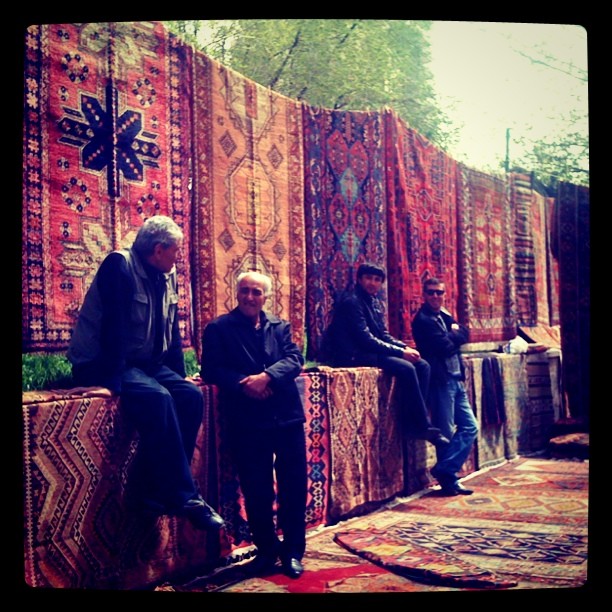
Vernissage market, Yerevan. Photo: Nicholas Babaian, CC BY-SA 2.0, via Wikimedia Commons.
Why buy an Armenian carpet?
Are you taking a trip to Armenia? Then do not forget to buy an Armenian carpet! Admittedly, they can be found abroad, but the selection in Armenia is ever wider. And, the icing on the cake, the prices are very affordable, one more reason to check our practical guide to Armenia before you set off.
Before ordering your carpet, do not hesitate to ask the seller a few questions to learn the history and detailed explanation of the symbols the carpet contains. It is an object of decoration, certainly, but it is also a work of art, since there is a story and a meaning behind each symbol.
As you will have gathered, the selection of carpets is ever wider. The choice is therefore not easy to make! To be sure of making the right choice, it is best to be accompanied by a specialist who will help you avoid being cheated. Charlatans are everywhere!
Plan your visit
Want to bring home a genuine hand-woven carpet? Build your own itinerary or book an all-inclusive tour with local experts who can guide you to the right workshops, and discover more of the country’s art, music and literature along the way.